
New technologies in terms of Webperf are regular, but some advances have more impact than others on the tech sphere. Today we are going to follow up on the previous article on HTTP / 2 and SEO by addressing the topic of HTTP / 3. Techno which, you will see, will not immediately replace HTTP / 2 which has not yet said its last word.
As a reminder, HTTP / 2 solved the problem of the number of resource download channels, but there is still a plethora of concerns to be resolved to put an end to these pages with endless loading. And a concern is often a problem for SEOs , because the associated recommendations are expensive and/or obscure. We are, of course, referring to Time To First Byte, otherwise known as TTFB!
WHAT PROBLEMS REMAIN AFTER SWITCHING TO HTTP / 2
The Time To First Byte is the time required for the first byte to arrive on a device in order to load a page. It is therefore the first measurable time on the user side.
The concern when detecting a bad TTFB is that it can be due to several issues that are often associated with the website infrastructure itself. We are therefore not on-site optimization but of course on optimizing the information path from the client to the server and then from the server to the client.
In order to understand how HTTP / 3 is going to change things, it will be necessary to understand in its entirety, how this first byte gets to the server and why this transfer is so long.
THE TCP PROTOCOL
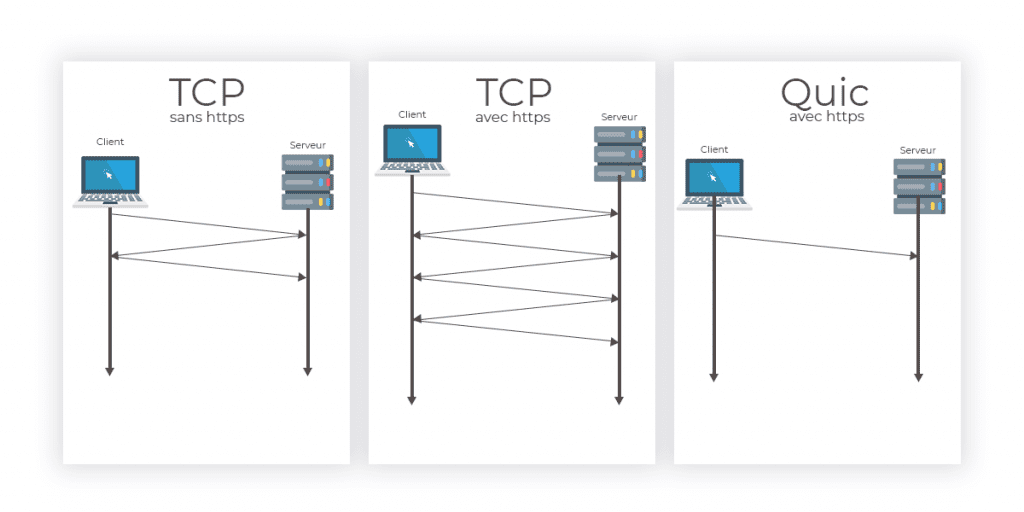
All HTTP protocols are based on the Transmission Control Protocol (TCP). This protocol guarantees data integrity. If a few packets get lost, the server resends them so that all the data can reach you.
To do this, many round trips are necessary to ensure that all packages are received and in the correct order. And if a packet is lost, you will have to wait for it to be resent before continuing with the other pending tasks.
THE UDP PROTOCOL
The UDP protocol is characterized by transfers that are faster because they are more direct and with fewer round trips. On the other hand, the transfers are not reliable because there is no packet loss control. If data is lost along the way, it is lost.
For some uses, packet loss is not a problem. This technology is useful in streaming or videoconferencing for example, because if a packet does not arrive, we will not wait for it to be retransmitted, the stream continues to run even if it means having some degraded images.
One can then wonder if the loss of packets is really blocking for the loading of a page, and the answer is generally yes, and this is where Quic comes in.
QUIC – A GOOGLE INITIATIVE
Web performance has always been a concern of Google and in 2012, an internal lab was created to look into a new way of efficiently sending web pages. This project is called Quic for Quick LJDP Internet Connections. Quic is a layer that is superimposed on the LJDP in order to guarantee correct operation and to avoid round trips inherent in the TCP protocol without worrying about packet loss.
FROM QUIC TO HTTP / 3
Quic or rather http over Quic is then taken over by IETF in order on the one hand to create a new standard, HTTP / 3, which is largely based on Quic technology. In addition to standardizing the protocol, the IETF is also working to improve technology to ensure proper operation in the future.
It is important to note that Chrome, Firefox, Edge and Opera already support HTTP / 3 and that other browsers are working on it. Techno is therefore well advanced.
ADVANTAGES AND DISADVANTAGES OF HTTP / 3
ADVANTAGES OF HTTP / 3:
- The technology considerably reduces the latency and therefore the TTFB of the web pages on which the technology is implemented.
- HTTP / 3 solves the problem of Head of Line blocking, a bottleneck due to the loss of packets, because as a reminder in TCP, a lost packet pauses the channel until the reception of the rescue packet sent by the server.
- Data security is improved with TLS 1.3 encryption.
- HTTP / 3 is supported by the most used browsers as well as by CloudFlare, Akamai …
CONS OF HTTP / 3:
- Little feedback because the techno is very fresh.
- Server CPU usage has increased significantly.
- Many private networks (business networks, public networks, etc.) block the use of the UDP protocol.
- The http / 3 is not yet usable by crawlers.
HTTP / 3 AND SEO
Can we already recommend or use HTTP / 3 as part of an SEO strategy? HTTP / 3 does not allow Googlebot crawling, so the technology is still too young to be useful for SEO purposes. The real question to ask is what impact will HTTP / 3 have on SEO in the future?
In terms of ranking, the impact should be low, but it is very common that the sites do not enter the nails of Google at the level of Time To First Byte. A priori, HTTP / 3 should be able to help you at this level. You can also save time on the rest of the waterfall in cases where you are faced with Head of Line Blocking.
The HTTP / 3 will come, anyway, in parallel with the HTTP / 2 in the same way that the HTTP / 2 is generally installed in cohabitation with the HTTP / I. 1.
SHOULD YOU GO TO HTTP / 3 TODAY?
The performance provided by HTTP / 3 does not justify the switch today, especially if we take into account the server load required in 99% of cases. If your site needs extreme performance at all costs, you can still give it a go and join the 3% of sites running HTTP / 3. It is too early to give a date on which the technology will be mature enough to be usable without side effects. All upcoming info will be announced in the Search Foresight newsletter.
CONTACT US FOR MORE INFORMATION